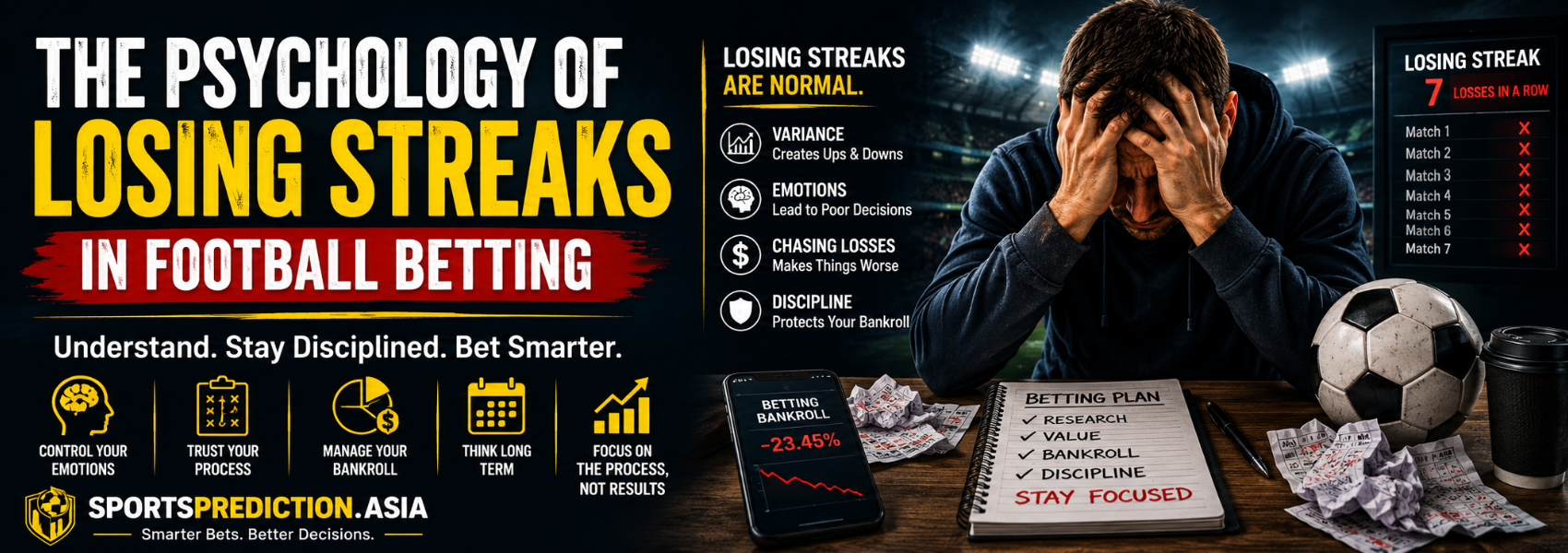
The Psychology of Losing Streaks in Football Betting
Every football bettor eventually experiences a losing streak.
It does not matter whether you are a beginner placing your first bets or an experienced bettor following a proven strategy. At some point, a series of losses will occur.
Unfortunately, many bettors are unprepared for the psychological impact of consecutive losses. What starts as a normal part of betting can quickly lead to frustration, poor decision-making, and significant bankroll damage.
Understanding the psychology behind losing streaks is essential for anyone who wants to approach football betting responsibly and improve their long-term decision-making.
Why Losing Streaks Are Inevitable
One of the biggest misconceptions in football betting is the belief that good analysis should eliminate losing streaks.
The reality is that football remains highly unpredictable.
A match can be influenced by:
-
Red cards
-
Injuries
-
Penalty decisions
-
VAR interventions
-
Weather conditions
-
Individual mistakes
Even when a bettor identifies value in the odds, the outcome may still lose.
This is known as variance — the natural fluctuation between expected outcomes and actual results.
Professional bettors understand that losing streaks are part of the game, not necessarily proof that a strategy has stopped working.
How the Human Brain Reacts to Consecutive Losses
Humans are naturally wired to avoid losses.
Psychologists refer to this as loss aversion, where the emotional pain of losing is often stronger than the pleasure of winning.
In football betting, this can create several psychological challenges:
Self-Doubt
After several losses, bettors begin questioning their analysis.
Thoughts may include:
-
"Maybe I don't understand football."
-
"Perhaps my strategy is broken."
-
"I should follow someone else's picks."
While self-evaluation is important, emotional self-doubt can lead to abandoning sound strategies prematurely.
Frustration
Repeated losses can create anger and disappointment.
Many bettors become obsessed with "getting back" what they lost rather than making objective decisions.
This emotional state often results in poor bet selection.
Fear
After a losing streak, some bettors become overly cautious.
They may:
-
Reduce stakes excessively
-
Avoid opportunities they would normally take
-
Stop trusting their research
Fear can be just as damaging as overconfidence.
The Dangerous Habit of Chasing Losses
One of the most common mistakes during a losing streak is chasing losses.
This occurs when bettors attempt to recover previous losses by:
-
Increasing stake sizes
-
Placing more bets
-
Betting on unfamiliar leagues
-
Taking higher-risk selections
The logic seems simple:
"If I can just win one big bet, I'll recover everything."
Unfortunately, this approach often leads to larger losses.
Professional bettors understand that no single bet should be responsible for recovering previous results.
Each wager should stand on its own merit.
The Gambler's Fallacy
Another psychological trap is the gambler's fallacy.
This is the belief that a win becomes more likely simply because several losses have occurred.
Examples include:
-
"I've lost five bets in a row, so I'm due a win."
-
"This team can't lose again."
-
"The streak must end soon."
Football matches are independent events.
Previous losses do not increase the probability of future wins.
Successful bettors focus on value and probability rather than emotional narratives.
Why Professional Bettors Think Differently
Professional bettors expect losing streaks.
Before placing any bet, they understand:
-
Expected win rate
-
Average odds
-
Potential drawdowns
-
Bankroll requirements
For example, a bettor with a profitable long-term edge may still experience:
-
5 consecutive losses
-
10 consecutive losses
-
15 consecutive losses
This does not automatically mean the strategy has failed.
Instead of reacting emotionally, professionals evaluate:
-
Whether they still find value
-
Whether their process remains sound
-
Whether market conditions have changed
Their focus remains on the long-term sample size rather than recent outcomes.
How to Stay Disciplined During a Losing Streak
Maintaining discipline is often more important than finding winners.
Here are several practical strategies:
Follow a Bankroll Management Plan
Never increase stakes simply because you are losing.
A consistent staking plan protects your bankroll from emotional decisions.
Review Your Process, Not Just Results
Ask yourself:
-
Was the analysis reasonable?
-
Did the bet offer value?
-
Would I place the same bet again?
Focus on decision quality rather than short-term outcomes.
Take a Break if Necessary
If betting becomes emotionally stressful, step away temporarily.
A short break can help restore objectivity and reduce impulsive behavior.
Track Every Bet
Keeping detailed records allows bettors to evaluate performance accurately.
Track:
-
Date
-
Match
-
Odds
-
Stake
-
Result
-
Reasoning
Over time, patterns become easier to identify.
Building Long-Term Mental Resilience
Mental resilience separates successful bettors from emotional bettors.
Strong betting psychology involves:
-
Accepting uncertainty
-
Understanding variance
-
Trusting a proven process
-
Remaining disciplined during adversity
No betting strategy wins all the time.
The goal is not perfection.
The goal is making consistently good decisions over hundreds of bets.
Final Thoughts
Losing streaks are one of the most challenging aspects of football betting, but they are also one of the most misunderstood.
Many bettors react emotionally by chasing losses, abandoning strategies, or making impulsive decisions. In reality, losing streaks are often a normal consequence of variance rather than evidence of failure.
The most successful football bettors understand that long-term profitability depends on discipline, bankroll management, and emotional control.
When losses occur, focus on the quality of your decisions, not just the outcome of individual bets. The bettors who survive losing streaks are often the ones who succeed in the long run.