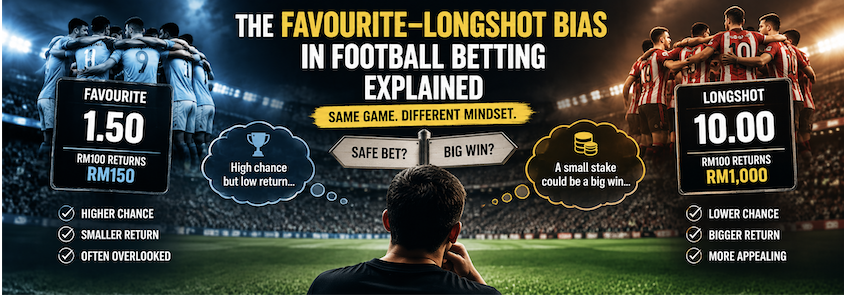
The Favourite–Longshot Bias in Football Betting Explained
Football bettors are often drawn to selections priced at 5.00, 10.00 or even 20.00. The potential return is exciting, especially when a relatively small stake could produce a sizeable payout.
This attraction is connected to a concept known as the favourite–longshot bias.
Understanding this bias can help bettors recognise why high odds can sometimes appear more attractive than the underlying probability justifies, and why a bigger potential payout does not automatically mean better betting value.
What Is the Favourite–Longshot Bias?
The favourite–longshot bias describes a tendency for bettors to place disproportionate value on unlikely outcomes with large potential payouts.
Consider two selections:
-
Favourite at 1.50
-
Underdog at 7.00
The favourite is more likely to win, but the 7.00 underdog offers a much more appealing return.
This can influence betting decisions. Instead of concentrating on whether the price accurately reflects the probability, bettors may become focused on what they could potentially win.
For serious football betting, those are two very different considerations.
Why Long Odds Are So Attractive
The appeal becomes obvious when comparing potential returns.
A RM20 stake at 1.50 produces a RM30 total return if successful.
At 10.00, that same RM20 produces RM200.
The second option naturally attracts more attention.
The danger comes when the size of the potential payout becomes more important than the probability of actually winning the bet.
This is particularly relevant with correct scores, accumulators, goalscorer markets and large underdogs.
High Odds Are Not the Same as Good Value
Imagine an underdog is available at 6.00.
Those odds imply roughly a 16.7% probability before accounting for bookmaker margin.
If your analysis suggests the team's actual chance of winning is only 10%, then 6.00 may still be a poor price.
If you believe the team has a 20% chance, the situation becomes different.
This is the foundation of value betting.
The important question is not whether the odds are high. It is whether the odds compensate you adequately for the probability of losing.
Short Odds Can Still Offer Value
Value betting does not mean constantly searching for outsiders.
A favourite can also be priced attractively.
Suppose a team is offered at 1.80, representing an implied probability of around 55.6%.
Your analysis estimates that the team actually has a 65% chance of winning.
In that situation, the relatively short price could still represent value.
A professional approach therefore does not automatically favour short or long odds. Each price must be evaluated against the estimated probability.
Where This Bias Appears Most Often
The favourite–longshot bias can become particularly relevant in football markets where very large payouts are possible.
These include:
-
Correct Score
-
First Goalscorer
-
Anytime Goalscorer outsiders
-
Large accumulators
-
Heavy underdogs
-
High handicap combinations
A correct-score selection at 25.00 naturally looks more exciting than an Asian Handicap bet at 1.90. However, an exciting potential payout tells you nothing by itself about whether the bet is fairly priced.
Why Big Wins Are Easy to Remember
High-odds betting can also affect how bettors remember their results.
Imagine placing numerous small bets at odds between 10.00 and 20.00.
Most lose, but eventually one produces a large payout.
That winner is memorable.
The previous losing tickets are much easier to forget.
Over time, this can create the impression that longshot betting performs better than it actually does.
Keeping a complete betting record helps prevent memorable wins from distorting your view of overall performance.
Social Media Can Make Longshots Look Better
The same effect appears across betting content on social media.
A successful 20.00 selection makes excellent content. It can generate screenshots, comments and shares.
A series of losing selections is far less likely to receive the same attention.
As a result, bettors may see many spectacular winners without seeing the complete betting history behind them. When evaluating a football tipster, look beyond individual winning slips. Consider total bets, average odds, ROI, stakes and long-term performance.
Low Odds Are Not Automatically Safe Either
The opposite mistake is assuming that short odds equal safety.
A selection priced at 1.25 can still lose.
More importantly, it can still represent poor value if the bookmaker's price is too short relative to the true probability.
This means neither of these assumptions works:
Low odds = good bet
High odds = good value
A strong betting decision depends on the relationship between price and probability.
How to Avoid the Favourite–Longshot Bias
Before placing a high-odds football bet, consider a few simple questions:
-
Am I choosing this mainly because of the potential payout?
-
What probability is implied by the odds?
-
Does my analysis support that probability?
-
Would I still consider the selection attractive without focusing on the possible return?
-
Does the bet fit my bankroll and betting strategy?
This helps shift attention away from excitement and back towards the quality of the betting decision.
Final Thoughts
The favourite–longshot bias shows how easily potential payouts can influence football betting decisions.
Large odds are exciting, but they should never be confused with value. At the same time, short-priced favourites should not automatically be considered safe or worthwhile.
The better approach is to evaluate every selection in the same way: estimate its probability, compare that estimate with the available odds, and decide whether the price justifies the risk.
In the long run, the size of the payout matters far less than whether you consistently take the right price.